TO INSPIRE YOUR BUYING CHEAP RURAL LAND AND BUILDING ON IT
Drive the country lanes one gas tank from your city home. Find a great piece of land. Knock on the farmer's door. "FOR SALE? SOME OF IT?" Before you buy it, dig deep into it with your shovel, see how deep the top soil is. Google 'top soil' and look at all the articles on the subject. BUY your farm with a GROUP as you are going to put various villas on it and a central, separate kitchen and meal hall. GROUP BUY TIPS
Put in your orchard and your vegetable garden following the EZ GARDEN TIPS you find at THE GARDEN INDEX. You can camp on it for years, coming on weekends. Once the orchard is in, you want to build the house. You can be inspired by JUNK RAIDERS show, Discovery and Ion TV has it... where they do a 500k remodel for 5k. And READ UP ON FREEBIE SUSTAINABLE BUILDINGOften there will be no land use taxes if you build a house on your land. Don't let a lack of money keep you from building. Do the house with regional organic methods. Tires, Strawclay, logs from the nearby forest. The important thing is the soil. Many of us own homes on very clay-like soil. This can be amended but it takes time before you can garden. However clay has a fabulous use. Building the stucco outside of your rural, country home! I wrote an expert about this.
DEAR TIV: The Clay soil in my yard is hard as cement after rains, when sun comes out it dries and Knives bounce off it. Shovel can't pierce a dune. Woe is me for moving here. But you're telling me I can mix straw with it, pour it into FORMS and let it dry into building bricks? What an idea? Clay/straw houses are just SOIL poured into plywood forms, right?
"ANSWER: There are a large number of building techniques that use earth. Some are traditional, like strawclay; some new, like earth-ships made from tires packed with dirt; some are updated versions of traditional methods, like adobe with added stabilizers so it will work in wet climates.
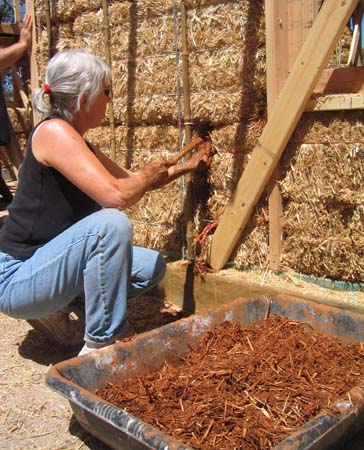
Strawclay is mostly straw packed into forms. There are also techniques that are mostly dirt either packed while only damp to poured almost like concrete. Wattle and daub is an other traditional infill for post and beam. It uses a woven layer of sticks (willow is traditional) and is covered in mud.
http://www.greenhomebuilding.com/strawbale.htm
Subscribe to a MAGAZINE on the theme maybe a good idea?
http://www.naturallifemagazine.com/9510/strawbale.htmMany of the GREEN BUILD SITES out there offer expensive courses, and sometimes not many CLUES on their sites. LUCKILY, the clerk at HOME DEPOT can show you most everything they propose or teach. And the NET can show you products offered and VIDEOS on the technology.
Concrete Canvas Shelters are rapidly deployable hardened shelters that require a light truck, an air pump and a water hose for construction. The key to CCS is the use of inflation to create a surface that is optimized for compressive loading. This allows thin walled concrete structures to be formed which are both robust and lightweight. CCS consist of a cement impregnated fabric (Concrete Cloth) bonded to the outer surface of a plastic inner which forms a Nissen-Hut shaped structure once inflated.
http://www.youtube.com/watch?v=LBHVKFCoYFc
To find best frugal method to get inspiration for 'instant houses' is to surf the net with keywords and FIND authors who have written books, then seek them as USED BOOKS. Google the subject of strawclay, wattle and daub, surfing the net and you will find hundreds of BOOK TITLES on this field, seeking those with copious PHOTOGRAPHS plus maybe interesting reviews. Often you can buy these books for 4$ or even a buck at ABEBOOKS.com Learn the entire ART out of a book! It surely is not ROCKET SCIENCE and one can learn from books, if the book's good enough, enough clear photo and diagrams. Even Real estate ads give you a look at innovative homes, these days, Try Google search term words like YURTS, strawclay solar home :
When you first buy your acre or two, as a farmer you want to make it fertile, fluffy semi acid black soil with WORMS in it ---BUT if it's CLAY don't worry. YOU CAN BUILD YOUR HOME out of the clay. EXCAVATE a big hole in this clay, (make a root cellar in the hole,) then you can take almost any soil and amend it with leaves, small branches, green crops and over a few months working on it, get it fluffy and acidic.
FOR TOOLS: GOOGLE YOUR WAY to USED TOOL SITES: There is a marketplace for buying and selling new and used farm machinery, equipment, seeds, crops, livestock and a wide range of services including job opportunities.Then garage sales for shovels, forks, picks.
When you have CLAY SOIL it's an asset FOR BUILDING walls of course adding cement, lime or sometimes even an oil like linseed oil and it becomes a stable building material. Cover the outside with a stucco of either cement or lime and it is weatherproof enough for any climate in the world.
A man named "Mark Lung" lived in a straw-bale house in Gunnison, Colo., before moving to Boise. While there, he carefully charted the temperatures over an extended period. The outside temperature ranged from 20 to 80 degrees. Inside, the temperature stayed between 68 and 72 - without supplemental heat or cooling. Google name, Colorado, Idaho, see if you can find articles with pictures.
Lung mounts enough rebar to go through the first straw bale into the cement foundation then uses sharpened bamboo to secure the bales on top of the first. The bales are set on two rails with a trough in the middle that is used for electrical conduit, which is sent up any of the posts that come every 8' in the wall. The dirt removed for the foundation is used in forming the wall plaster.
The whole house does not have to be straw and wattle At a list, T Canava says : I'm the cheapest person I know. Instead of buying a house I put an ad in the paper saying FREE HOUSE DEMOLITION... I got my pick of houses. I took the house that had best wood features apart and hauled it to my land and rebuilt it. (We assume he means doors, door frames, lumber, beams, bricks, features that give a country home BEAUTY.) Instead of paying thousands on a mortgage I pay $221.00 a month for the land." POSTER's NOTE: AMAZINGLY INGENIOUS!
MAUI WOWIE ARCHITECTURE. Now, next, we have HEMP HOUSE built out of a field of boo, marijuana plants, about to be a reality in California where sooner or later, the intoxicating "THINK weed" legalized by PROP 19
News has surfaced that using Hemp fibers in your Bricks makes them harder than concrete for homes and buildings! The French woman who reinvented the ancient use of hemp fibers for buildings put these NExT VIDEOS up. And if the house ever burns down, you can sit there and trip out.
http://www.youtube.com/watch?v=wRtDh6YUt-0
Building With Hemp Part 1/2 [English architects demonstrate the use of hemp in building a house.]http://www.youtube.com/watch?v=FcctSvVFheA&feature=related
Building With Hemp Part 2/2http://www.youtube.com/watch?v=b6eMdqJbQI4&feature=related
Hemp Processing [This is a very informative and important video showing the manufacturing of a
diversity of hemp products.]
http://www.youtube.com/watch?v=5k0GGWGTFII&feature=relatedNow, a dessert for your eyes, an amazingly beautiful,
spiritual, Medieval home in Wales. This would be easy to build. Cost this fellow 3thousand pounds, is that like 5k? HUGE, well fitted out with accessories and very pleasant on the eyes. Ya have a feeling if your local codes would allow this? They would if your architect DREW it right.
See more pics at: http://www.simondale.net/house/
http://greenbuildingelements.com/2008/12/01/hand-build-an-earth-sheltered-house-for-5000/
NOW for the most beautiful rustic home ever built, most inspiring design and style EVER....
http://www.simondale.net/house/build.htmDozens of GREAT WEB SITES can be googled if you search on "green + built+ Vermont" themes like BUILDING FOUNDATIONS INEXPENSIVELY
Before you do the house, BUILD AN "EARLY START" HOTBED, a "PLANT BUNKER" for your Spring seedlings, so you can push the 'plant seed' date up, earlier, ever earlier, protect tender greens from icy winds and early frosts. Then while you're building your house, your vegetable garden is racing to keep up with you so dinner will be on the table when you finish the kitchen! Don't bother with a laundry room in your MUD ROOM. You wash clothes in the patio as YOU DRY THEM ON A LINE out there. RAINY WEATHER you do not wash as there's no inside DRYER in a country CABIN. SEE how they did it with two buckets and a stick. https://pioneerthinking.com/how-pioneers-washed-clothes
~^~^~^~^~^~^~^~^~^~^~^~^~^~^~^~^~^~^~
Our POSTER is ANITA SANDS HERNANDEZ, Los Angeles Writer, Mother of 4, Futurist and Astrologer. Catch up with her websites TRUTHS GOV WILL HIDE & NEVER TELL YOU, also The FUTURE, WHAT'S COMIN' AT YA! & HOW TO SURVIVE the COMING GREAT DEPRESSION, and Secrets of Nature, HOLISTIC, AFFORDABLE HEALING. Also HOW TO LIVE on A NICKLE, The FRUGAL PAGE.* Anita is at astrology@earthlink.net ). Get a 35$ natal horoscope "my money/future life" reading now + copy horoscope as a Gif file graphic!
<===BACK TO MONEY SECRETS ONLY THE EXPERTS KNOW
<=== BACK TO SECRETS THE GOV DOES NOT WANT YOU TO KNOW
<=== SHOW ME "THE FIX" INDEX PAGE.
<== SHOW ME THE HAPPY R)EVOLUTION PAGE
<=== BACK TO "GUERILLA CAPITALISM" -- THE SOLUTION!
<=== BACK TO REAL CAUSES OF THE MELTDOWN -- a WEBPAGE
<------BACK TO THE VULTURE SANDWICH, WORLD STARVATION INDEX PAGE
<------ BACK TO HOW TO STEAL A CORPORATION FROM THE STOCKHOLDERS
<=== GUERILLA CAPITALISM FOR YOU AND ME!
<----- BACK TO THE IMPORT EXPORT TRAINING SEMINAR
<----- BACK TO THE LEGACY TRADE SEMINAR
<=== BACK TO TRACKING THE ECONOMY, an INDEX PAGE
<===BACK TO THE ACTIVIST'S EASY BREEZY METHOD FOR EVOLUTION
<=== BACK TO THE EASY, BREEZY, NO WORK AT ALL GARDEN ARCHIVE for urban farmers
<===BACK TO THE REAL ESTATE SECRETS WEBSITE. POOR MEN CAN BUY HOMES!
<== BACK TO HEALING MINDS For A NEWAGE COMMUNITY, PSYCHIATRY YOU CAN CALL "TANTRUM YOGA"
<====BACK TO THE HOLISTIC GOURMET, BON MARCHE
<=== BACK TO THE GLEENERS PAGE
<=== BACK TO THE FRUGAL INDEX PAGE
<== BACK TO THE FUTURE INDEX PAGE
<=== BACK TO THE GENTLEMAN FARMER'S GARDEN INDEX
<=== INVESTIGATE DOING DRIP IRRIGATE- LINES in DROUGHT STATES for big $, learn in l hr flat at HOME DEPOT
<=== BACK TO THE MALTHUSIAN INDEX PAGE, WHY GOV WANTS US ALL DEAD
<=== BACK TO THE PORTAL to 7,000 ARTICLES YOU CAN REPUBLISH FREE, ATTRACT AD REVENUE
