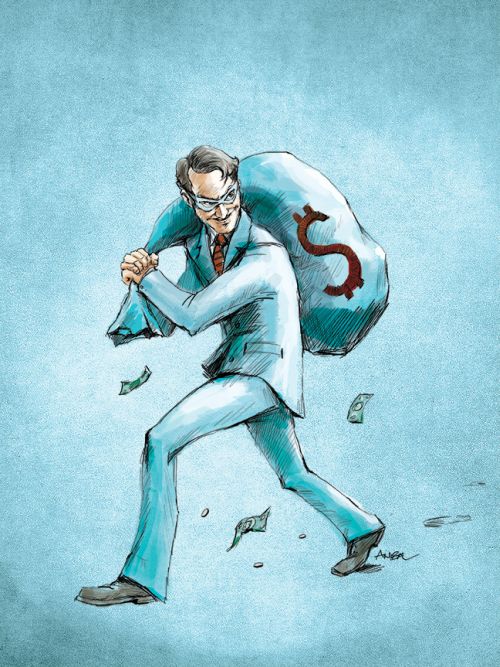
The 10 Greediest People in USA
By Sam Pizzigati, Too Much: A Commentary on Excess and Inequality
http://www.alternet.org/story/114782/This time of year always seems to bring a never-ending barrage of "top ten" lists. The
year's top ten movies, the top ten books, the top ten news stories, and on and on. Here at
Too Much we've decided to join in on the action -- with our very own list of America's
top ten greediest.We probably couldn't have picked a better year than 2008 to so "honor" our most
avaricious. This year's stunning economic meltdown has fixed the attention of our entire
nation -- and world -- on the grasping antics of those who yearn for ever more than they
could rationally ever need.But this year also presents enormous challenges for anyone bold enough to rank the
greedy. With so much greed out there, how could we possibly limit our list to a mere ten?The latest greed explosion to hit the headlines -- the $50 billion Bernie Madoff Ponzi
scheme -- illustrates just how difficult a task ranking the greedy can be.To whom in this scandal should we award the most greed points? Bernie Madoff himself,
the 70-year-old who scammed his wealthy friends and charities to keep up his credentials
as a Wall Street investing "genius" -- and maintain a $6 million pad in Manhattan, a
waterfront mansion in Palm Beach, and a weekend getaway on Long Island?Or should those greed points go instead to the ever-so-sophisticated hedge fund
"middlemen" like Walter Noel, who built a five-manse fortune by steering clients to Madoff
and charging them tens of millions in "due diligence" fees for the steering.Or should the greed points go to Madoff's investors themselves, the swells who pay
$250,000 a year for the privilege of belonging to a swanky country club?So many choices! How about James Cayne, the Bear Stearns CEO who rode toxic
securities into billionairedom? Or Angelo Mozilo, who took the same ride at Countrywide
Financial, spreading suffering to subprimed families all along the way?In the end, we came to realize, the size of the fortune alone doesn't determine greed. It's
the thought that counts. In that holiday spirit, we hope you find our top ten greedy list of
some interest -- and greed-busting inspiration.10: Dwight Schar
Any list of 2009's greediest has to start, of course, with the power-suits who pumped up
-- and profited ever so lavishly from -- the now-burst housing bubble. In November, Wall
Street Journal researchers scoured the records of firms that build and finance housing and
found 15 top executives who have pocketed, "in cash compensation and proceeds from
stock sales," at least $100 million over the past five years.Among the fortunate 15: Dwight Schar, the chair of homebuilding giant NVR Inc. The
66-year-old Schar has cleared $625 million since 2002. In 2004, he spent a good chunk
of that buying an ocean-facing mansion in Florida's Palm Beach for $70 million, the highest
price up to then ever paid for a U.S. residential property. The seven-bedroom home came
with a walk-in humidor for cigars.Schar's legal residence, a gated estate just north of Washington, D.C., sits on 10 acres
overlooking the Potomac. NVR stock has dropped over 60 percent since its housing
bubble peak, but neither of Schar's two main residences figures to foreclose anytime soon.9: Patrick Soon-Shiong
Why does health care in the United States cost so much? Maybe somebody should ask
Patrick Soon-Shiong, the Los Angeles drug developer who this September saw his
personal fortune -- $3 billion last year -- take a giant first step toward more than doubling.Soon-Shiong came into 2008 as the chief executive of APP Pharmaceuticals. He stepped
down as CEO in the spring, but the former surgeon still held 83 percent of the company's
shares. In July, he agreed to sell APP to a German firm. The sale finalized two months later
for an initial $3.7 billion cash payment.What made APP so attractive? The company is minting money. In 2007, notes the Los
Angeles Business Journal, APP scored $253 million in adjusted earnings on just $647
million of sales. The firm started this year off on an equally profitable tear when a
contamination scare in China left APP the only U.S. source of a widely used
blood-thinner. That drug quickly doubled in price.8: Richard Baker
This hasn't been a great year for the hedge fund industry. The funds -- largely unregulated
investment vehicles open only to deep-pocket investors -- are suffering their worst year
ever, down 19 percent through November. But the industry has certainly been sweet this
year to at least one lucky fellow, former Congressman Richard Baker from Louisiana.Back in February, Baker gave up his House seat -- and his $169,300 House salary -- to
become the president and CEO of the Managed Funds Association, the hedge fund
industry's trade association.What led the 60-year-old Baker, a lawmaker since the age of 23, to give up his life of
public service? Maybe the private gain. As the hedge fund trade group chief, the New
Orleans Times-Picayune reported earlier this year, Baker would be taking home
a $1 million annual salary and benefits package.What made Baker so attractive to America's hedge fund billionaires? As the chair of the
House Financial Services Subcommittee on Capital Markets, the Center for Responsible
Politics notes, Baker had been overseeing the very industry he would, as the hedge fund
top gun, be representing.7: James Mulva
Back last spring, with motorists turning purple with rage every time they pulled in for a
fill-up, one Big Oil CEO tried to assure Americans he shared their pain. Declared
ConocoPhillips chief exec Mulva: "High oil prices have not been our friend" -- because, as
he explained later to reporters, higher per-barrel prices for crude have resource-rich
countries demanding more control over their own oil.On the other hand, the run-up in crude oil prices over recent years hasn't exactly left Big
Oil broken-hearted. The industry's profits, the Consumer Federation of America noted this
fall, have soared over 600 percent since 2002.Few have enjoyed more rewards for that success than the 62-year-old Mulva. He reaped
a $50.5 million personal payoff in 2007, according to federal Securities and Exchange
Commission figures. He'll be collecting, when he retires, at least a $2.6 million annual
pension.6: Ralph Roberts
On January 1, 2008, the Comcast cable TV empire put into effect the ultimate in executive
incentive pay plans: a new deal that guaranteed the company's founder and executive
committee chair, Ralph Roberts, $1.85 million in basic annual salary for five years after he
dies, with the after-death payout going to whoever Roberts names as his beneficiary.In 2007, Roberts, now 88, actually pocketed $24.7 million in total compensation. His son,
current Comcast CEO Brian Roberts, collected $20.8 million.Some shareholders, in early 2008, took a bit of umbrage to all this largesse. Some even
began demanding Brian's resignation. In February, under fire, the Roberts clan backed
down. They agreed to ax Ralph's death benefit and drop his annual salary to $1 a year.
But Comcast will continue to pay Ralph's various benefits, including his life insurance. In
2006, the premiums ran $10.5 million.Meanwhile, in November, news reports revealed that federal and state cable TV
regulators fear that Comcast, amid the consumer confusion over the transition to all-digital
over-the-air broadcasts, is pushing low-income cable TV subscribers into more expensive
monthly cable packages.5: Steve Jobs
In 2008, once again, the most notable executive in America's $1-a-year CEO club
remained Steve Jobs, the chief exec at Apple Computer. Jobs has been collecting a mere
$1 in annual salary ever since 1997. He has, to be sure, been collecting a few other
rewards as well. He entered 2008 with about 5.5 million shares of Apple stock and a net
worth not too far south of $6 billion.This past March, to gain some input into any future rewards that might come their CEO's
way, Apple shareholders passed a resolution that gives them an advisory "Say on Pay"
vote on executive compensation. Joked Jobs in response: "I hope 'Say on Pay' will help
me with my $1 a year salary."Apple corporate directors aren't waiting for any shareholder help. In the company's 2008
proxy statement, they noted that they're already "considering additional compensation
arrangements" for Jobs, given the "critical" importance of his "continued leadership."Jobs himself told shareholders at this year's Apple annual meeting that he "feels confident"
that any number of the company's top execs "could take his place." Even so, he was probably
eager to see what sort of "additional compensation" Apple's imaginative board might have
in mind. In 1999, the board gave Jobs a $90 million Gulfstream V jet -- and agreed to pay Jobs for
the cost of operating it. In 2007, that cost came to $776,000.So in effect, they just threw
800 APPLE pcs off a cliff.
4: Robert Stevens
Peace on earth and good will toward everybody. But not too soon. That may be the motto
this holiday season for Lockheed Martin, the world's biggest military contractor. Under
CEO Robert Stevens, the company's profit margins have nearly doubled, thanks in no
small part to a 72 percent hike in U.S. defense outlays, after inflation, since the year 2000.And the future looks equally bright, even with the war in Iraq winding down. Lockheed
Martin, the 57-year-old Stevens noted last month, sees nothing but "continuous expansion"
in its military hardware sales overseas. These sales can deliver sky-high returns, industry
analysts point out, because U.S. taxpayers have already footed the bill for the hardware's R&D.Still, Stevens isn't putting all his eggs in one basket. Lockheed Martin, he said last week,
remains totally "unconstrained" by the credit crisis and is now investigating making
corporate acquisitions in other fields -- like health care.The CEO's personal financial health remains quite robust. Stevens pulled in $26 million last
year. The most highly decorated general in the U.S. armed services would have to work
over 130 years to make that much.3: Larry Ellison
No state may be suffering from the bursting of the housing bubble more than California --
and no Californian may be benefiting from that bursting more than billionaire Larry Ellison,
the Oracle business software chief exec who currently occupies the three-spot on the latest
Forbes list of America's 400 richest.Ellison spent nine years and $200 million building a lavish Northern California residential
estate -- in the flamboyant style of a 16th century Japanese emperor. In 2005, San Mateo
County officials assessed the 23-acre property at $166.3 million. Ellison balked. A more
accurate appraisal, his lawyers claimed, would run about $100 million less.Early this spring, the San Mateo assessment appeals board came down on the side of
Ellison's lawyers. That decision handed Ellison a $3 million tax refund.Local public schools are now bearing about half the burden that refund has generated. In
future years, Ellison's tax discount will cost Portola Valley schools an annual $250,000 or
so, the cost of hiring and supplying three teachers.Ellison, as Oracle's top executive, takes home about that much every hour. This August,
just before school started, Oracle pay filings revealed that Ellison collected $84.6 million in
fiscal 2008 for his CEO labors. He also cleared another $544 million cashing in on a stash
of his Oracle stock options.2: John Thain
In high-finance circles, they called John Thain "Mr. Fix-It." In 2004, the New York Stock
Exchange hired Thain, a rising star at Goldman Sachs, to clean up the mess after NYSE
CEO Dick Grasso departed with a scandalous $140 million retirement package. Then, in
October 2007, Merrill Lynch asked Thain to pick up the pieces after Merrill's board gave
the heave-ho to CEO Stanley O'Neal, who left with $160 million.Merrill paid fairly dearly to gain Thain's services. Mr. Fix-It came on board with a $15
million signing bonus and a bundle of lush incentives that "would be considered excessive
for any industry anywhere," observed CEO pay expert Graef Crystal, "except on that tiny
slice of Manhattan called Wall Street."With subprime-spooked financial giants starting to melt down all around him, Thain went
to work wheeling and dealing -- and assuring bystanders that all would be well. In July, he
told investors he "felt comfortable with Merrill's capital levels." In August, Thain labeled his
firm "well-positioned for the coming years."Well, maybe not that well-positioned. In September, as Reuters later reported, Merrill
would come within moments of "total extinction" -- only to be rescued, an hour before
Lehman Brothers declared bankruptcy, when Bank of America agreed to swallow Merrill
whole.Merrill Lynch, Thain apparently believed, had been fixed, and, early this December, he let
it be known that he expected up to $10 million in new bonus for his efforts -- despite
Merrill's $12 billion in 2008 losses and a pending layoff of as much as a fifth of the firm's
workforce. On top of all that, Merrill's new sugardaddy, Bank of America, was taking $25
billion in taxpayer bailout dollars.Thain's bonus request quickly became a public relations disaster. By mid-December,
Merrill and Thain, under increasing pressure, would unrequest the bonus millions. The
good news for Mr. Fix-It? He still may get a $5.2 million "change-of-control payment" for
selling Merrill -- and he still has a job.Unlike average families who lost everything when Merrill's subprime mortgage securities
went sour, Thain still has a house, too. A nice one, a 14-bedroom palace north of
Manhattan complete with tennis courts, swimming pools, and a fish-filled private lake.1: Richard Gilman
The CEO of a small factory on Chicago's North Side, by Fortune 500 standards, rates as
distinctly small-time. But this particular CEO, Richard Gilman, helped make headlines --
and history -- in 2008. He fully deserves this year's premier place in America's top ten
greediest.Gilman started running Republic Windows and Doors, a modest, four-decade-old plant, in
2006. Layoffs soon followed, and, eventually, only about 240 workers remained from a
unionized labor force once over 500 strong.Those workers, earlier this fall, realized something even more ominous was coming at
them. Equipment at the Chicago plant had started vanishing. What the workers didn't
know: Republic's "deciders" had set up a new company and bought a nonunion window
and door plant in Iowa.Two days into December, Republic gave workers the bad news. The plant would shut
down three days later. The workers would lose their earned vacation time and their health
insurance -- and not see any of the severance legally due them.Just another typical assault on workers with a precarious foothold in the middle class. Or
so things seemed. But the workers then did something extraordinary. Reviving memories of
the Great Depression-era "sit-down" strikes, they occupied the plant -- and captured
America's imagination.The sit-down forced Gilman and his money pot, the Bank of America, to the bargaining
table where a settlement soon took shape. But Gilman suddenly threw a monkey-wrench
into the works -- and gained a slot for himself in this year's top ten greediest.Gilman demanded that "any new bank loan to help the employees also cover" the lease of
his Mercedes and BMW and eight weeks of his $225,000 salary.The workers would have none of that. Gilman would drop his demand. The bank funding
would come through. The workers had won. Greed had lost.That hasn't much over the last three decades. Maybe the greedy have finally gone too far.
We may have reached the end of an era. America's generation-long Great Greed Grab
may soon be no more.Sam Pizzigati is the editor of the online weekly Too Much, and an associate fellow at
the Institute for Policy Studies.© 2008 Too Much: A Commentary on Excess and Inequality All rights reserved.
View this story online at: http://www.alternet.org/story/114782/
* * * * * * * * * * * * * * * * * * * * * * * * * * * * *
Our 'POSTER-BLOGGER' is ANITA SANDS HERNANDEZ, Los Angeles Writer, Researcher, Humorist, Ombudsman, mother of 4 and career Astrologer. Catch up with her websites TRUTHS GOV WILL HIDE & NEVER TELL YOU, also The FUTURE, WHAT'S COMIN' AT YA! FRUGAL LIFE STYLE TIPS, HOW TO SURVIVE the COMING GREAT DEPRESSION, and Secrets of Nature, HOLISTIC, AFFORDABLE HEALING. Also ARTISANRY FOR EXPORT, EARN EUROS....* Anita is at astrology@earthlink.net ). Get a 35$ natal horoscope "my money/future life" reading now + copy horoscope as a Gif file graphic! No smarter, more accurate career reading out there!
<=== BACK TO TRICKS CORPORATIONS DO TO TAKE ALL THE MONEY
<=== BACK TO TRACKING THE ECONOMY, an INDEX PAGE
<===BACK TO MONEY SECRETS ONLY THE EXPERTS KNOW
<=== BACK TO SECRETS THE GOV DOES NOT WANT YOU TO KNOW
<===BACK TO THE SECRETS OF THE OLIGARCHS, THE EMPIRE INDEX PAGE
<=== SHOW ME THE FIX INDEX PAGE.
<== SHOW ME THE HAPPY R)EVOLUTION PAGE
<=== BACK TO "GUERILLA CAPITALISM" -- THE SOLUTION!
<=== BACK TO SCREEN WRITING, NOVEL WRITING, the BIG $$
<====BACK TO IMPORT/EXPORT BIZ, TRAVEL THE WORLD, HELP 3rd WORLD ARTISANS, MAKE $$
<==== BACK TO THE "VITAL SIGNS OF A DYING ECONOMY" the "FUTURE" WEBPAGE
<==== BACK TO THE WALL STREET MELTDOWN WEBSITE, with "WHAT TO DO TO SURVIVE" TIPS
<=== BACK TO ALEXANDER HAMILTON & HIS DAMN BRIT BANKS, WHICH STARTED IT ALL
<====BACK TO THE HOLISTIC GOURMET, BON MARCHE
<=== BACK TO THE GLEENERS PAGE
<=== BACK TO THE FRUGAL INDEX PAGE
<== BACK TO THE FUTURE INDEX PAGE
<=== BACK TO THE GENTLEMAN FARMER'S GARDEN INDEX
<=== INVESTIGATE DOING DRIP IRRIGATE- LINES for big money, LOW start up costs/minimal training
<=== BACK TO ACTIVISM IS A DELIGHT & CREATES CAREERS as well as PLANETARY EVOLUTION
<=== BACK TO THE MALTHUSIAN INDEX PAGE
<===BACK TO THE PHILOSOPHY INDEX PAGE
<=== BACK TO THE LUCK IN LOVE WEBSITE, HOW TO MARRY WELL!
<== BACK TO THE PROPAGANDA STUDIES WEBSITE, HOW GOV LIES TO YOU
<=== BACK TO ALL POINTS OF THE COMPASS POLITICAL PHILOSOPHY TUTORIAL
<=== BACK TO JERRY'S REFRIGERATOR & the Tin Foil Hat Collection of CONSPIRACY THEORIES!
<====BACK TO THE FREE MONEY WEBSITE
<==== BACK TO THE HARD TIMES WEBSITE
<===== BACK TO THE POVERTY INDEX PAGE
<==== BACK TO THE "TIPS to SURVIVE THE FUTURE" INDEX PAGE
EARN AD REVENUE. FREE PUBLISHING RIGHTS TO YOU, ALL FILES ARE YOURS TO USE. FREE! CREATE A WEBSITE
BACK TO THE "FIX YOUR FLAGGING AMBITION" SEMINAR
WITH LOTS OF TRENDY ARTICLES and YOU WILL GET HITS. MY HOMESPUN PGS got ME ADVERTISERS. LOTSA $$
signed, Anita Sands Hernandez, astrology at earthlink. net<=== BACK TO "IT'S THE ECONOMY STUPID" AN ARCHIVE AND INDEX PAGE