The BANK OF ENGLAND
WHY DID BANKS TAKE OVER THE PLANET?
Because they COULD! History of THE bank.

Through these doors pass the richest, fattest most heartless bastards
that ever lived. They own the world. Just TRY taking it away from them!In the mid-1700s the American Colonies were prospering, in part because
they were issuing their own money called "Colonial Scrip," which was
strictly regulated and did not require the payment of any interest. When
the bankers in Great Britain heard this, they turned to the British
Parliament, which passed a law prohibiting the Colonial Scrip, forcing
the colonists to accept the "debt" or "fiat" money* issued by the Bank
of England. Contrary to what history teaches, the American Revolution
was not ignited by a tax on tea. According to Benjamin Franklin, it was
because "the conditions [became] so reversed that the era of prosperity
ended." He said:"The Colonies would gladly have borne the little tax on tea and other
matters had it not been the poverty caused by the bad influence of the
English bankers on the Parliament, which has caused in the Colonies
hatred of England and the Revolutionary War."To look at Banking/ money in another way. The 1930's crash put millions
out of work and into slavery ( Hoover dam construction as an example).
WHILE all the resources were there for folk to work ( except the fiat $$ to oil
things) the oligarchs had built up the credit bubble and wanted to burst it so as to buy assets 5
cents on the $ which is what they did.and kept money in shorts supply
and as soon as there is a WAR on the horizon comes another opportunity
to make $$$$ and more power...........Top playwright Harold Pinter was on a TV program and for 1 hour he summed up the US foreign policy since 1945.. the only thing I would dissagree with is that Britain is the poodle ( plenty of info puts it that the US is the poodle of the Brits~ see Dr John Coleman's work) http://mailstar.net/british-conspiracy.html
But we hear more and more that US folks are doing 3 jobs to survive ( or to keep up with buying better cars or appliances than the neighbour! Or UPDATING their home to DIY standards, or putting their child through trade school.)
TV makes folks discontented and envious --always dreaming that those goodies are theirs. Or watching sports ( Adrenal Opiates for the masses) Cheering for your team, with a dose of repulsion for blood, like the gladiator days of Rome!!! Anything to keep folks pre occupied so they cannot see what is happening and reduce their ability to THINK. Or the hours that they could be THINKING in.
What's your understanding of PUTIN? I think he's upset the American Oligarchs by moving on the old Pre-1989 Russian, oil-rich satellites again like a pasha for whom there's NO ex wife!
Most every country has a Government in waiting and it would appear we
are in the last dash each time things get worse and the public do
nothing ( that is effective ) The headline hurricanes are never over. Each day more and
more comes out on 911 but folks have become immune and are switched off so we get little hurricanes, pre-cooked: PEOPLE HISTORY COM has 12 HEADLINE stories each year to keep us not talking about high taxes, low wages. Just comb thru that site. it's a wonderful example of how effective OLIGARCH PROPAGANDA IS! It totally feeds us a meal a month!The big one in the first 15 yrs of our century was 911. Even though 911 was the illegal BUSH SENIOR & DICK CHENEY WEAPONS OF MASS DESTRUCTION LIES "FRAME" for the crap war/ murder in Iraq......... More folks are being suicided (droned, blown up, assassinated ---not only our GI's but millions of Muslim families, civilians across Afghanistan, Iraq, Syria, Yemen) .......The media are so blatant with their lies that the only reason Joe sixpack cannot see what is happening is down to distracted, entertained by other things, propaganda, conditioning of the reactive mind, hatred of Muslims, racism and all that is mind control.
And the young are being got at every which way ..... . first rampant student loan and credit card debt which leaves them saturated with food and stuff on credit, huge ongoing interest rates on principle, worried, apprehensive, not paying attention to the truth, just automatically buying into the propaganda and saturated with creepy, psycho Pop /Satanic music from costly, trendy 'must have' CDs subliminals .... ( note how some "interviewers " of pop creeps even ask " When did so & so sell his soul to the devil. Take note of the folk wearing a hexagram ( I guess you know where the expression " puta da hex on you " comes from !!) see:
http://www.geocities.com/Heartland/7006/mcfadden-frb.html
http://www.reformation.org/secrets-of-the-bank-of-rome.html
and this essential reading to understand why "Banks" took overhttp://www.u-s-history.com/pages/h256.html
More Evidence on the Bank of England
©1998 by Gerry Rough
This essay is an add-on to the first essay I wrote on the history of the Bank of England. With this essay, all of the arguments the conspiracy theorists have written on this issue in book form will have been dealt with exhaustively, at least to my knowledge. The few arguments that are not dealt with were considered to be too trivial. There are some other arguments on this issue as well that were skipped because I chose to stick with the history and the operations of the Bank itself, without getting too far off course. There are a few here that overlap my first essay, but all of the arguments presented are new material. Let’s take a closer look at the credibility of the conspiracy theorists on this issue. G. Edward Griffin, author of The Creature from Jekyll Island is our first writer examined:
"England was financially exhausted after half a century of war.... Unable to increase taxes and unable to borrow, Parliament became desperate for some other way to obtain the money.... There were two groups of men who saw a unique opportunity arise out of this necessity. The first group consisted of the political scientists within the government. The second was comprised of the monetary scientists from the emerging business of banking.... The two groups came together and formed an alliance. No, that is too soft a word. The American heritage dictionary defines a cabal as “A conspiratorial group of plotters or intriguers.” There is no other word that could so accurately describe this group.... The Cabal met in Mercer’s chapel in London and hammered out a seven point plan which would serve their mutual purposes".
Now let’s take a look at the accuracy of Griffin’s paragraph. His narrative from here almost immediately begins to show serious signs of fabrication. The two groups mentioned, the “monetary scientists” and the “political scientists,” never existed. At this point, Griffin has fabricated two historical boogiemen for his reader. There are no historical accounts anywhere that detail a meeting between any two groups that formulated the idea for what would later become the Bank of England. Griffin had to have known this since his main historical source for this passage is R.D. Richards, one of the premiere writers on the Bank of England. In no historical accounts of the era is any credit ever given to other than that of William Paterson alone for the founding of the Bank of England. Of the three standard works on the early history of the Bank of England, Richards is the only one cited in Griffin’s bibliography. Richards’ text even directly contradicts Griffin’s assertion of a private meeting between two groups that formed the Bank of England:
The Bank was established, under the authority of sixteen sections of the Tunnage Act of 1694, for “the better raising and paying into the Receipt of the Exchequer the sum of Twelve hundred thousand pounds, Part of the sum of fifteen hundred thousand pounds.” Their Majesties were authorized to appoint Commissioners to receive subscriptions on, or before, 1st August 1694, by “any person or persons, natives or foreigners, bodies politic or corporate,” who, provided the full loan or “a moiety thereof” was subscribed before 1st August 1694, were to be incorporated
under the title of “The Governor and Company of the Bank of England.”[3]As you can see, a public subscription for a new joint-stock enterprise has been deliberately twisted into a private meeting of “a conspiratorial group of plotters or intriguers.” Further, Richards states two pages later:
The Bank’s original capital of £1,200,000 was quickly subscribed. Narcissus Luttrell, the diarist of the day, states that the subscription lists were opened in “the Mercer’s Chappel” on 21st June 1694; that the Lords of the Treasury “came themselves and subscribed £10,000 for the Queen”; that Sir Robert Howard, the auditor of the Exchequer of Receipt, and his son were responsible for £18,000 and Sir John Houblon for £10,000; that the total of subscriptions for the first day amounted to £300,000, and for the first three days to £600,000, which meant that the subscribers became a corporation, and that by noon on 2nd July the total of £1,200,000 had been completed.
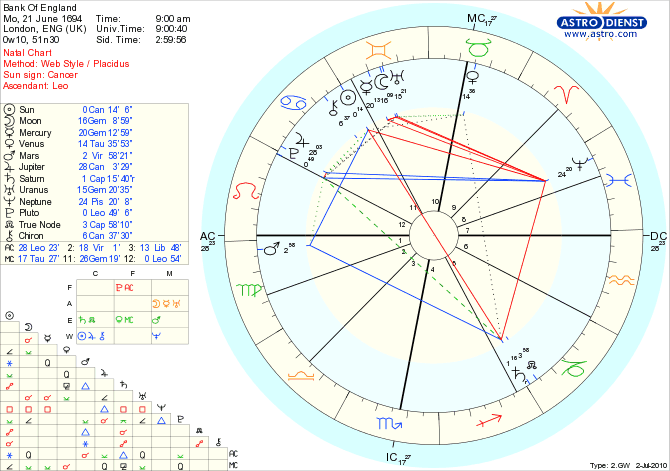
The astrological stresses of giant cardinal grand squares which hit the planet EARTH in JULY 2010 height of the recession, hit the SUN of this chart smack on, the Ruler of the Bank of ENGLAND, that sun being in zero cancer. That summer had a T square involving up to 5 malefic planets. They lost a lot of money then. The next date is more of a strategy for survival and that hit AUGUST 2012 when the LONDON BASED OLYMPICS were about to start. They let the inflation beast out of the box for as soon as the OLYMPIC village was built and the workers left, the BANK OF ENGLAND had a huge debt that renting that Olympic Village they'd just built couldn't fix. A great U.K tour would be SKITTLEFIELDS today. See what they did to that village.
The above is on the very page that Griffin himself cited. Griffin had full knowledge that the meeting at Mercer’s Chapel was a public invitation to a subscription list, yet deliberately fabricated otherwise. Further, even if we confine ourselves only to Richards’ text which Griffin used, we find quickly that chapter 4 is entitled “Tudor and Stuart banking schemes.” Chapter four begins thus:
The petitions, propositions, “humble proposals” and “seasonable observations” appertaining to banks and banking, the earliest of which appeared in England during the Tudor period, increased in number and in volume during the Stuart regime, particularly during the two decades preceding the foundation of the Bank of England. They form an important field of economic literature from which it is evident that a large number of Tudor and Stuart writers fully realised the need of a well-organised credit system. The great expansion of English domestic and overseas trade in the seventeenth century created big financial problems; the many banking schemes which accompanied this expansion give an excellent insight into the wide commercial activities of this
important era.[5]From here Richards’ chapter cites literally dozens of banking schemes dating as far back as the sixteenth century. Even Paterson himself was rejected twice before finally submitting a workable concept for a bank. Clapham mentions upwards of “several scores of financial schemes” for a Bank of England,[6] Glyn Davies’ text even cites “100 or more schemes for a public bank.”[7] It is clear that the founding of the Bank of England was a development dating as far back as the sixteenth century, far from any conspiracy of the late seventeenth century. It is clear as well that Griffin’s statement has been fabricated.
You will also note that Griffin mentions a “seven point plan which would serve their mutual purposes.” This as well has been fabricated. The accounts of the era never hint of this, and his reference sources for this document are historical narratives of the era written 300 years after the fact, having no relation to a specific document written in the late seventeenth century Griffin’s text all but admits the obvious fabrication in his footnote to the seven point plan, citing an “overview” rather than a specific document or reference source for the document:
For an overview of these agreements, see Murray Rothbard, The Mystery of Banking (New York: Richardson & Snyder, 1983), p. 180. Also Martin Mayer, The Bankers (New York: Weybright & Talley, 1974),pp 24-25.[8]
Bill Still, author of On the Horns of the Beast: The Federal Reserve and the New World Order describes the same set of events this way:
Frantic government officials met with money changers to beg for the loans necessary to pursue their political interests. The price was high. The money changers demanded nothing less than a government-sanctioned privately-owned monopoly over monetary power—over who got to coin or print English money. Naturally, the monopoly would be owned by a combination of money changers, and the English monarchy, and would be designed for their exclusive profit.[9]
Still’s fabrication on this issue is simply breathtaking. It is extremely unlikely that any
government in history has ever given its authority to coin or print money to a private enterprise. In order for this act to take place, parliament would have to pass a law allowing for the sale of the English mint. It is certain that the English mint was never sold since this event is not mentioned in any known texts on the subject. Both the law itself and the subsequent sale of the mint would be impossible to miss as a significant historical event. The sale of the English mint is not mentioned in any of Still’s reference sources either. It is clear in this instance that Still’s statement has been fabricated.Still’s ignorance on the issue of the history of the Bank of England is perfectly understandable when viewed from his bibliographical reference sources. Of the 37 reference sources in his bibliography, there are no serious historical accounts of the Bank of England. Without exception, all of his reference sources on this issue are conspiracy theory writers. It is interesting to note as well that most of these are heavily anti-Semitic in content. On the issue of anti-Semitism, Still even admits his own blindness to the anti-Semitism of one of his main sources for the history of
the Bank of England. Still writes:Some authors make the mistake of saying that the Scotsman William Paterson led the English money changer group, but Commander William Guy Carr, writing in 1958 -- despite his silly, anti-Semitic contention that Calvinism was the invention of a Jewish conspiracy designed to cause a split in Christianity—gives what is probably the most accurate account.[10]
It is difficult to imagine that Still could be so blind after reading the obvious anti-Semitic writings of William Guy Carr and still cite him as a credible source of information. For Still to miss Carr’s obvious incompetence from his anti-Semitic bias is analogous to missing the forest from the trees. It is clear from the above that Still’s own admission of Carr’s anti-Semitism calls into serious question his own credibility.
He claims that Paterson only conducted the negotiations with money changers on behalf of the English government and that the other party to the negotiations were: “money lenders WHOSE IDENTITY REMAINED SECRET.”[11]
The statement is a classic example of multiple absurdities contained in the same statement. There were no negotiations, no money changers, Paterson did not work on behalf of the English government, and the money lenders whose identity remained secret were actually London merchants. The real money lenders of the era were actually the goldsmith bankers, not the London merchants whom Paterson represented.
According to Carr, the system set into motion with the chartering of the Bank of England was a system of perpetual debt from which no nation is meant to escape: “The international bankers never intended that England be allowed to pay off the national indebtedness. The plan was to create international conditions which would plunge ALL nations concerned deeper and deeper into their debt.” Believe it or not, this is actually what transpired. The Parliament was so desperate and/or so bribed, that they accepted these terms, which amounted to nothing less than legal counterfeiting of a national currency for private gain. The initial stock offering sales pitch for the Bank read: “Paterson hath benefit of interest on all moneys which it, the bank, creates
out of nothing.”[12]Again, Still’s fabrication of fact here is simply breathtaking. There are no known historical records that remotely suggest that any members of Parliament were bribed in any way. Further, his next idea of “legal counterfeiting,” is grossly absurd. The term counterfeit means to imitate or copy with the intent to defraud— strictly illegal. The term “legal counterfeiting” is an oxymoron—a self-contradictory statement. Governments alone have the power to declare any currency legal tender, making it impossible to legally counterfeit a legal currency.
Still’s quote on the initial stock offering sales pitch for the bank has a story of its own. The quote is one of the most widely used in all of conspiracy theory writings. It takes its life from a book entitled Tragedy and Hope: A History of the World in Our Time by professor Carroll Quigley of Georgetown University. First published in 1966, the book is widely read and used by conspiracy theorists in their vain attempts to prove a global conspiracy. It should be noted as well that Quigley himself repudiated conspiracy theories. The quote comes from page 49 of Quigley’s text. The original quote is as follows, “the bank hath benefit of interest on all moneys which it creates out of nothing.” A quick re-read of the above quote from Still reveals not one but two falsifications contained in the same quote. Here again, Still’s source for the quote is another
conspiracy theorist, Eustace Mullins, author of The Secrets of the Federal Reserve, who has falsified his data, unbeknownst to the hapless Still.[13] Further, Griffin as well is incapable of correctly quoting the same passage: “the Bank hath benefit of interest on all the moneys which it, the Bank, creates out of nothing.”[14] If either Still, Griffin or Mullins had bothered to check Quigley’s accuracy, he would have found that Paterson never made any such statement in the circular mentioned. The circular that Quigley mentions was published in 1694, and took as its title, A Brief Account of the Intended Bank of England.[15]Here is another story to the same events. The author of this version is Eustace Mullins, author of The Secrets of the Federal Reserve. The Mullins version is as follows:
"In 1689, the same group of bankers [the bankers that financed Cromwell’s seizure of power in 1649] regained power in England by putting King William of Orange on the throne. He soon repaid his backers by ordering the British treasury to borrow 1,250,000 pounds from these bankers. He also issued them a Royal Charter for the Bank of England, which permitted them to consolidate the National debt (which had just been created by this loan) and to secure payments of interest and principal by direct taxation of the people. The Charter forbade private Goldsmith’s to store gold and to issue receipts, which gave the stockholders of the Bank of England a money monopoly. The goldsmiths also were required to store their gold in the Bank of England vaults. Not only had their privilege of issuing circulating medium been taken away by government decree, but their fortunes were now turned over to those who had supplanted them.[16]
Here we have yet another version of the beginning of the Bank of England. In this version is King William of Orange ordering the British Treasury to borrow 1,250,000 pounds to repay his backers. Mullins’ next statement that the Bank of England was permitted to directly tax the people is absurd. This is nowhere mentioned in the charter, nor anywhere in any historical accounts of the era. The Charter, by the way, never forbade private goldsmith’s to store gold or issue receipts. Neither were the goldsmith’s required to store their gold in the Bank of England vaults. Glyn Davies has a decidedly different story to tell: A few important goldsmith bankers, especially Charles Duncombe remained stubbornly hostile, but the value and convenience of having an account with the Bank soon began to be widely appreciated, so that in general the goldsmith’s followed the example of Richard Hoare and of Freame and Gould (forerunners of Barclays) who both opened accounts in the Bank in March 1695. In the course of time the goldsmith’s gave up their own note issues and used Bank of England notes instead, to their mutual advantage.[17]
Des Griffin describes the 1694 events another way:
As British strength and influence grew around the world toward the end of the 1600s the wealth, strength and influence of the elite merchants in the City also grew—only at a faster pace. In 1694 the privately owned Bank of England (a central bank) was established to finance the profligate ways of William III. The bank was financed by a group of City merchants who used William Paterson as a ‘front.’ The names of the founders have never been made public.[18]
In Des Griffin’s text, it is mentioned that the Bank of England was somehow financed by the City merchants. Here Des Griffin has fabricated his data for his audience. It is nowhere stated that this was the case. Quite the contrary, it is stated everywhere that it was the original stockholders who financed the Bank in the beginning.
As you can see from the arguments presented so far, the conspiracy theorists are sorely lacking in serious research on the history of the Bank of England. Part two will examine more of what the conspiracy theorists have said on this issue, then conclude with a summary.
Sources
1) G. Edward Griffin, The Creature from Jekyll Island (Appleton:
American Opinion Publishing, Inc., 1995) 175, 176
2) Until the twentieth century, there were no major comprehensive historical narratives on the history of the Bank of England. The are now three major works; Clapham, Richards, and Andreades, although Richards was not meant to be a comprehensive work.
3) R.D. Richards, The Early History of Banking in England (London:
Frank Cass and Company, Ltd., 1958) 146
4) Richards, p. 148-149
5) Richards, p. 92-93
6) Sir John Clapham, The Bank of England: A History (New York: The
Macmillan Company, 1945) Vol. 1, p. 17) Glyn Davies, A History of Money: From Ancient Times to the Present Day (Cardiff: The University of Wales Press, 1994) 254
A FASCINATING FILE ON the HISTORY OF BANKING ........ VAULTS OF GOLD WHICH CAN STEAL FROM MEN.
POSTER is ANITA SANDS HERNANDEZ, Los Angeles Poster, Researcher, Writer, mother of 4 and career Astrologer. Catch up with her websites on the FUTURE, HOW TO SURVIVE the COMING GREAT DEPRESSION, and Secrets of Nature, HOLISTIC, AFFORDABLE HEALING. Also HOW TO LIVE on A NICKLE, The FRUGAL PAGE.* Anita is at astrology@earthlink.net ). Get a FREE natal horoscope a money/life & DESTINY reading --- + copy chart as Gif file graphic!
<===BACK TO SECRETS THE OLIGARCHS DO NOT WANT YOU TO FIND OUT
<=== BACK TO THE OLIGARCH INDEX PAGE